Global Aircraft -- T-38 Talon
|
Aviation Center
US Attack
US Bombers
US Cargo
US Fighters
US Helicopters
US Patrol/Pursuit
US Reconnaissance
US Tankers
US Trainers
US UAV's
US X Planes
Orbiter Vehicles
WWI Aircraft
WWII Aircraft
Airbus
Antonov
Boeing
Dassault
Ilyushin
Kamov
MiG
Mil
Saab
Sukhoi
Tupolev
Yakovlev
Joint/Rest of World
Entertainment Center
Members Center
New Technologies
Contact Us
Extra Navigation
GAC Engine
T-38 Talon Specifications
T-38 Talon Features
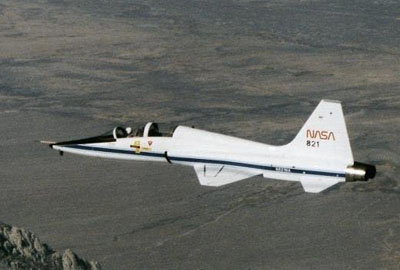
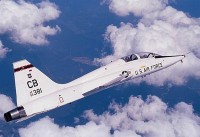
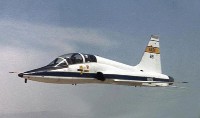
The T-38A has swept wings, a streamlined fuselage and tricycle landing gear with a steerable nose wheel. Two independent hydraulic systems power the ailerons, rudder and other flight control surfaces. The instructor and student sit in tandem on rocket-powered ejection seats in a pressurized, air-conditioned cockpit. Critical components are waist high and can be easily reached by maintenance crews. The T-38A needs as little as 2,300 feet (695.2 meters) of runway to take off and can climb from sea level to nearly 30,000 feet (9,068 meters) in one minute. Source: http://www.af.mil
T-38 Talon Background
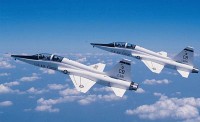
Advanced JSUPT students fly the T-38A in aerobatics, formation, night, instrument and cross-country navigation training. Test pilots and flight test engineers are trained in T-38A's at the U.S. Air Force Test Pilot School at Edwards Air Force Base, Calif. Air Force Materiel Command uses the T-38A to test experimental equipment such as electrical and weapon systems. Pilots from most North Atlantic Treaty Organization countries train in the T-38A at Sheppard AFB, Texas, through the Euro-NATO Joint Jet Pilot Training Program. The National Aeronautics and Space Administration uses T-38A aircraft as trainers for astronauts and as observers and chase planes on programs such as the space shuttle. Air Education and Training Command uses a modified version, the AT-38B, to prepare pilots for fighter aircraft such as the F-15, F-16 and A-10. The AT-38B has a gun sight and practice bomb dispenser. The Talon first flew in 1959. More than 1,100 were delivered to the Air Force between 1961 and 1972 when production ended. Pacer Classic is a program designed to extend the structural life of the T-38 to 2020. Future major modifications to the T-38 avionics systems will result in all Talons being redesignated as T-38C models. Source: http://www.af.mil

 Stumble This! Stumble This!
 Bookmark on Delicious! Bookmark on Delicious!
| ||||||||||||||||||||||||||||||||||||||